Resource Reallocation with Carbon Emission Policies
Winner, Tomas Björk Best Paper Prize 2024 (Swedish House of Finance) · Presented at LSE Environment Camp 2025
Abstract
This paper examines the effects of carbon policies on capital reallocation and emission reductions in the economy. It uses a model that captures the interactions between green and brown capital, productivity, and emissions. The model is estimated using data from the Swedish manufacturing sector between 1990 and 2015.
Key Findings
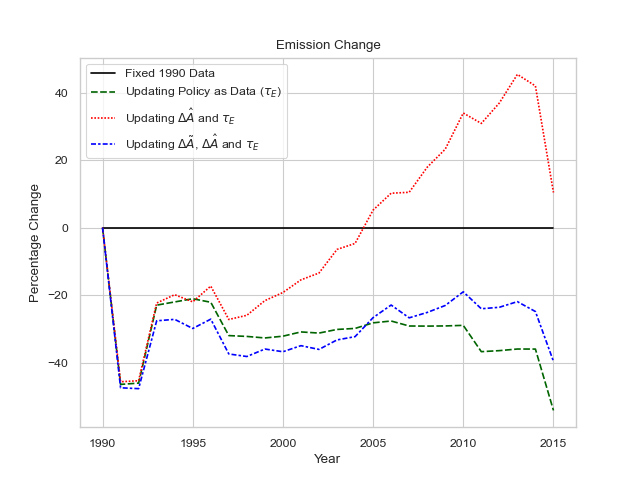
The elasticity of substitution between green and brown capital is lower in high-emission industries. The emission tax accounts for a 54% reduction, and technology improvements add another 50%. Productivity growth raises emissions by 64%, leading to a net 40% reduction overall. To meet a 75% reduction target by 2040, the tax rate must increase by 270% above current levels.
Policy Implications
The emission tax is the most effective policy instrument. Achieving equivalent reductions through green capital subsidies would require unrealistic interest rate discounts and would reduce total output significantly.