The Two Faces of VC Networks: Performance Premiums and Entry Deterrence
 Trends in capital reallocation and emissions in Swedish manufacturing, 1990–2015
Abstract
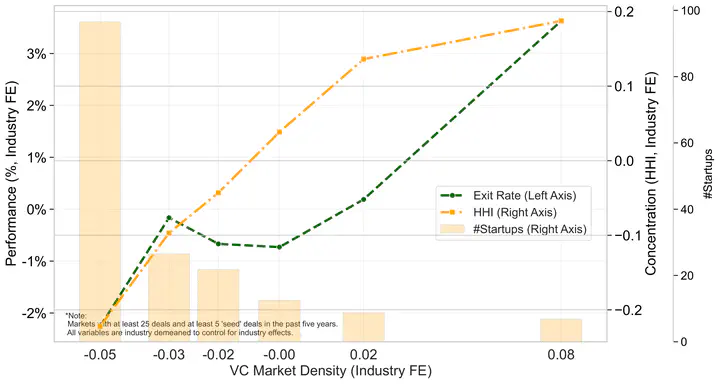
This paper presents a dynamic model of venture capital (VC) networks to study how financial intermediation affects startup performance and market entry. The model combines a one-to-many matching model with a repeated game on a fixed syndication network. It highlights three main mechanisms: assortative matching, in which well-connected VCs back higher-quality startups; value-added, in which network connections improve exit outcomes; and entry deterrence, in which repeated syndication allows VCs to coordinate and limit funding to startups that compete with those already in their portfolios. The first two mechanisms help the market, while the third reduces competition, creating a balance between efficiency and competition. The model also explains when collusion can be sustained through network-based punishments and makes clear predictions about matching, funding, and market concentration. This work lays the groundwork for future structural estimation.